Costa Rica struck gold for a century, beginning with a crude provisional coinage at a gold mill in 1825 and ending with the colones of the 1920s. In between came the San José escudos of the Central American Republic and the Indian-woman escudos of the young republic. We buy all of it, raw or certified. We pay prices that rival the auction houses, and you don't wait months for your money.
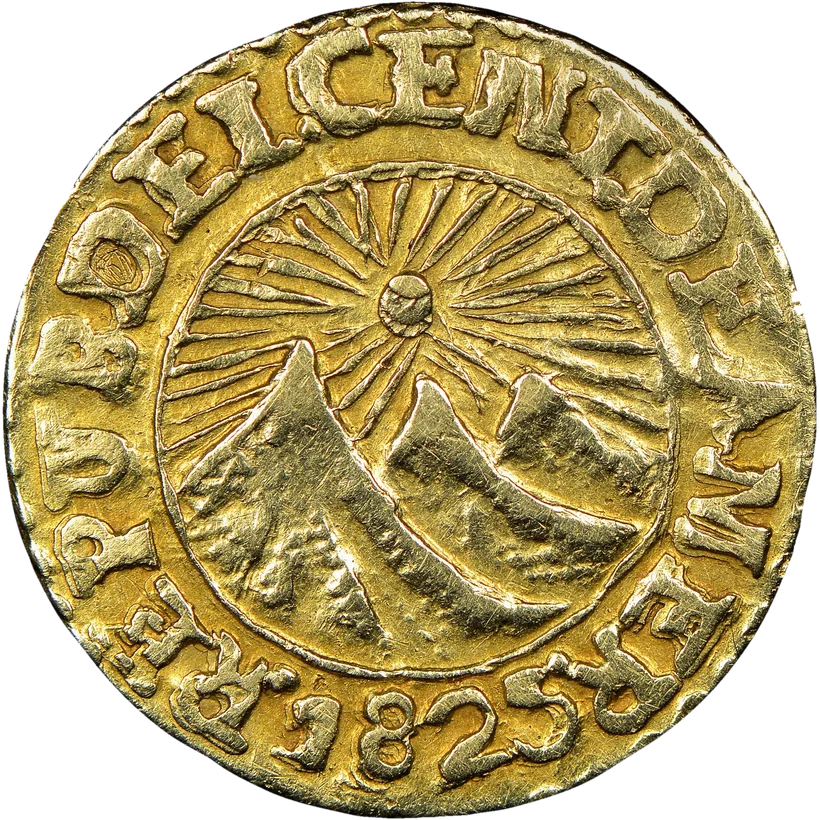
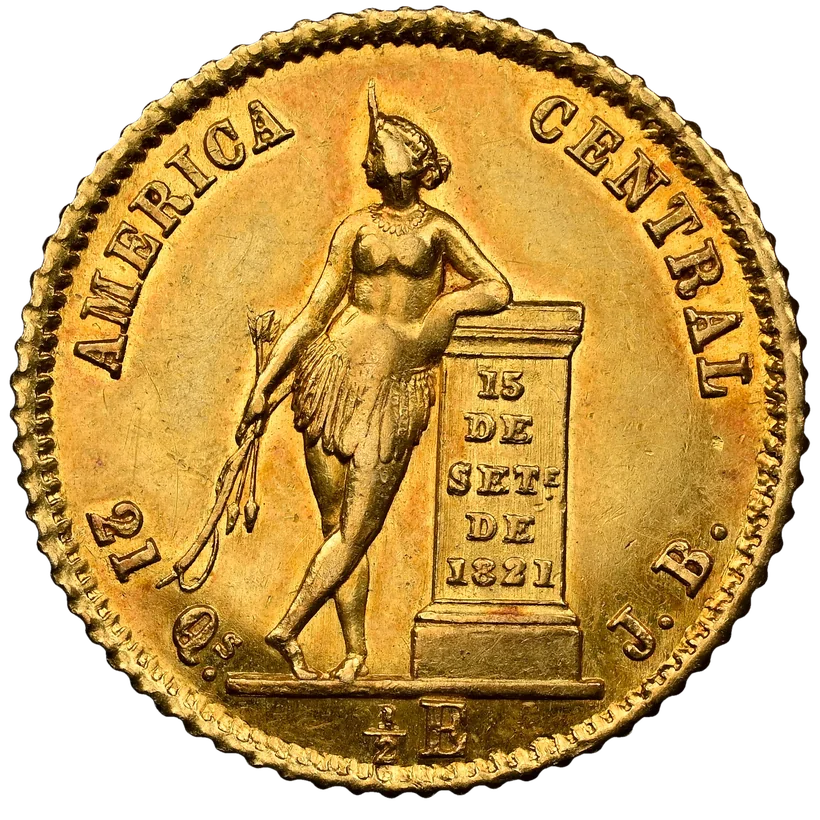
1825 Costa Rica provisional, Los Horcones1864 JB Costa Rica 1/2 Escudo
Los Horcones, 1825
In 1822 Manuel Alvarado built a mill to work the gold of the Montes del Aguacate, the Ingenio de Metales San José de los Horcones, near Río Grande in Alajuela. In February 1825 a provisional mint was set up there under the Spanish mining engineer Mateo Urandurraga, whose initials M.U. appear on the coins. The dies were cut by hand. One side carries the sun over three peaks with an abbreviated REPUBLICA DEL CENTRO DE AMERICA and the date 1825. The other carries a palm tree rather than the tree on the federal coins, with LIBRE CRESCA FEC, the value, CR, MU and 21Q. That palm drew an official complaint that it would hurt the coins' credit, and the public rejected them as crude. Striking stopped the same year, and the coins were later withdrawn and melted.
The half escudo is the denomination known today, about 16 millimeters and 1.8 grams. Only a handful survive. Larger values are recorded in the literature, but no example has been confirmed. If you have an 1825 Costa Rican gold coin with a palm tree, we want to see it.
The Central American Republic at San José
The San José mint was decreed in October 1828 and opened in January 1829. Under the federation it struck the sun-and-volcanoes escudos with the mint mark CR, in 8, 4, 2, 1 and half escudos, with assayer F, Félix Mora, and later E, M and JB. Costa Rica kept using the federal dies into 1850. Those coins have their own page.
From 1849 the government stamped many half and 1 escudos with a small lion in a circle and the legend HABILITADA POR EL GOBIERNO, often on both sides. A lion counterstamp is a collected variety, not damage. Costa Rica also struck a 1 escudo in its own name in 1842, as the Estado de Costa Rica, with assayer MM.
The Indian-woman escudos, 1850 to 1864
A decree of 1848 gave the republic its own gold, from dies cut by Wyon in England. One side carries the arms with REPUBLICA DE COSTA RICA and the date. The other carries a standing Indian woman with bow and quiver, leaning on a column inscribed 15 DE SETe DE 1821, with AMERICA CENTRAL, 21 Qs, the assayer and the value. The assayers are JB, Juan Barth, and from 1854 GW, Guillermo Witting.
Half escudo: 1850, 1851, 1853, 1854, 1855 and 1864. The 1864 is the last year of the type.
1 escudo: 1850, 1851, 1853 and 1855.
2 escudos: 1850, 1853, 1854, 1855, 1858, 1862 and 1863.
4 escudos: 1850 only. Dies for an 8 escudos were made, but none was struck.
On some coins the figure's chest was deliberately flattened, on the die or on the coin. Collectors pursue that variety.
Pesos and colones
Decimal gold followed in pesos from the 1860s to the 1870s, and from 1897 the colones with the bust of Columbus, in 2, 5, 10 and 20 colones. We buy those too.
What affects the offer
Type, date and assayer. Anything from Los Horcones, the 1850 4 escudos, the 1864 half escudo, the 1842 state escudo and lion-counterstamped gold are the coins collectors compete for.
Strike. A well-struck Indian-woman half escudo is hard to find, and it is worth more.
Jewelry. Costa Rica's small gold was set in brooches and pendants for generations, so solder, loop scars, bezel marks and polishing are common. Each lowers the offer, but none of them stops us buying.
Grade. Most survivors are Very Fine to About Uncirculated.
Certification is welcome but not required. We buy raw coins and price them on what we see.
What to send
A clear photo of the front and back of each coin. A short video, turning the coin in the light, helps too. Phone photos are fine, and if a coin is in a holder, photograph it in the holder.
Dates and catalog numbers
Each row is confirmed in at least two independent sources. Other dates and varieties exist, so if yours isn't listed, send it anyway.
½ escudo, Los Horcones provisional, 1825
Date
Mint
Assayer
Catalog
Notes
1825
CR
MU
KM-11
Provisional, hand-cut dies; few known
1 escudo, 1842, Estado de Costa Rica
Date
Assayer
Catalog
Notes
1842
MM
KM-33.1
One-year type; variety with EST
½ escudo, Indian woman, 1850 to 1864
Date
Assayer
Catalog
Notes
1850
JB
KM-97, Fr-10
1851
JB
KM-97, Fr-10
1854
JB
KM-97, Fr-10
1855
JB
KM-97, Fr-10
1864
JB
KM-97, Fr-10
Last date
1 escudo, Indian woman, 1850 to 1853
Date
Assayer
Catalog
1850
JB
KM-98, Fr-9
1851
JB
KM-98, Fr-9
1853
JB
KM-98, Fr-9
2 escudos, Indian woman, 1850 to 1862
Date
Assayer
Catalog
Notes
1850
JB
KM-99, Fr-8
1854
JB
KM-99, Fr-8
1854
GW
KM-99, Fr-8
Scarcer assayer for the year
1855
JB
KM-99, Fr-8
1855
GW
KM-99, Fr-8
1858
GW
KM-99, Fr-8
1862
GW
KM-99, Fr-8
Scarce
4 escudos (½ onza), Indian woman, 1850
Date
Assayer
Catalog
Notes
1850
JB
KM-100, Fr-7
One-year type
Counterstamped gold, 1837 to 1849
Date
Mint
Assayer
Catalog
Notes
ND (1841–42), on 1837 4 escudos
CR
E
KM-29, Fr-2a
Six-pointed star counterstamp, decree of 24 December 1841; few known