We buy Ecuador escudos.
The Quito mint struck its first gold escudo in March 1833 and its last gold in the 1850s. In between came the sun-over-the-mountains escudos, the onza that Melville nailed to the mast in Moby-Dick, and the Bolívar portraits. We buy all of it, and the later 10 sucres and condor struck abroad, raw or certified. We pay prices that rival the auction houses, and you don't wait months for your money.
Send photos of your coins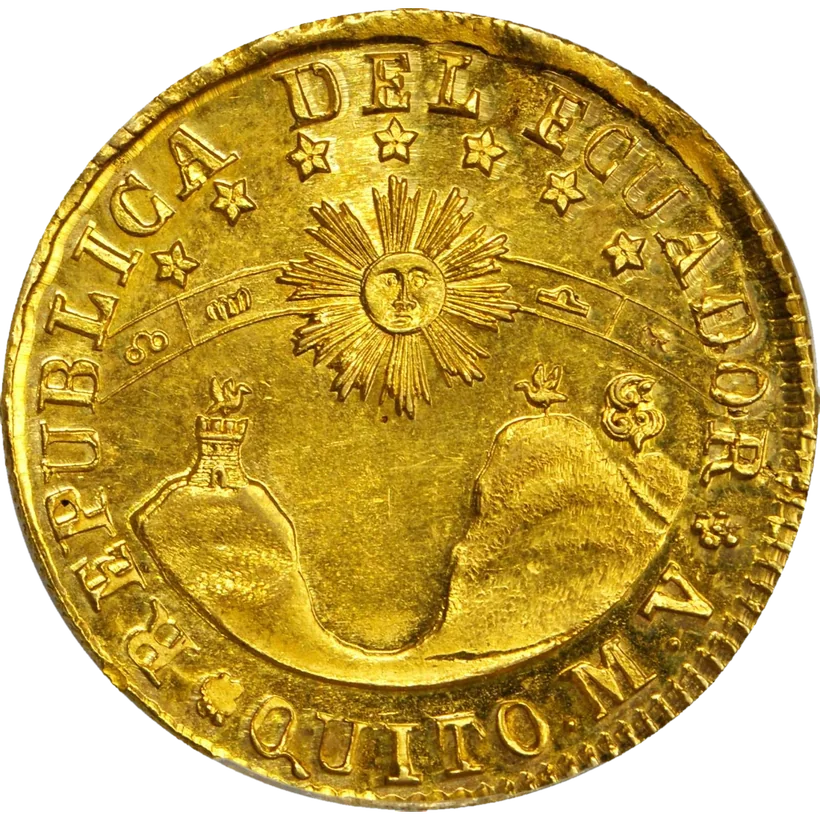
The series
The national side carries REPUBLICA DEL ECUADOR over a radiant sun, a band of the zodiac, and mountain peaks each topped by a bird, with QUITO and the assayer's initials beneath. A decree of June 1836 added seven stars for the seven provinces, and the 4 and 8 escudos carry them. The other side is a head of Liberty facing left with LIBERTAD on her band, the legend EL PODER EN LA CONSTITUCION, and the fineness, date and value along the bottom: 21 quilates, which is .875 gold. The earliest pieces, from 1833 to mid-1835, read EL ECUADOR EN COLOMBIA instead of the republic's name.
The mint began small. The 1 escudo was struck from 1833 to 1835 with assayer GJ. The 2 escudos, called a doblón, followed in 1834 and 1835, with GJ and, in 1835, also FP. The 4 escudos, the media onza, followed from 1836 to 1841, first with FP and then MV. The 8 escudos was authorized in February 1838 and struck through 1843, almost all with assayer MV; an 1838 with the initials ST is also recorded. A second letter appears on the 4 and 8 escudos, and it is not a second assayer but the engraver's mark in Liberty's drapery: an A in the front fold, already on the FP 4 escudos from 1836 and on the onzas through 1841, and a smaller bust with an S in the back fold from 1841 to 1843. Catalogues and grading labels write these as MV-A and MV-S, or run them together as MVA and MVS. An 1842 onza therefore reads QUITO MV with the S in the drapery.
Then Bolívar. The 1844 8 escudos with assayer MV, with Bolívar facing right, is unique; a second example reported stolen in Ecuador has never been traced. The 1845, with Bolívar facing left and a condor on the arms, is rare, and is known in two varieties, with and without flagpoles below the arms. From 1847 to 1856 the mint struck the Bolívar onza with assayer GJ again, and that is the Ecuador 8 escudos a collector is most likely to own, with overdates in 1849, 1852 and 1855 and a revised hairstyle in 1856. No Quito gold of 1833 to 1843 is common; the recorded mintages are patchy and not to be trusted. The mint closed in 1863, and the later gold, the 10 sucres of 1899 and 1900 and the 1928 condor, was struck abroad. We buy those as well.
What affects the offer
Date and letters first. The 1844 and 1845 Bolívar onzas are the great prizes. Among the 1838 to 1843 onzas, the 1838 is seen least, the 1841 exists with both drapery letters, and the MV-A and MV-S dies are collected as separate types. The 1835 FP 2 escudos and the whole run of small gold are scarcer than their prices sometimes suggest.
Then strike and surfaces. Quito's work was crude and uneven, and that is part of the character: an off-center or weakly struck example is normal, and the centers of the Bolívar heads are often soft. None of that is damage. What lowers an offer is cleaning, hairlines from an old polish, a scratch, a removed spot, or a repair, all of which turn up regularly on this series. Most survivors grade Very Fine to About Uncirculated. About Uncirculated is the usual state of a nice onza, and Mint State is genuinely uncommon. Gold was forged in Quito between 1838 and 1842, the onza most of all, and we check every piece for it. Certification is welcome but not required. We buy raw coins and price them on what we see.
What to send
A clear photo of the front and back of each coin. A short video, turning the coin in the light, helps too. Phone photos are fine, and if a coin is in a holder, photograph it in the holder.
Dates and catalog numbers
Each row is confirmed in at least two independent sources. Other dates and varieties exist, so if yours isn't listed, send it anyway.
| Date | Mint | Assayer | Catalog | Notes |
|---|---|---|---|---|
| 1838 | QUITO | MV-A | KM-23.1, Fr-3 | First year |
| 1838 | QUITO | ST-A | KM-23.1, Fr-3 | Assayer ST |
| 1839 | QUITO | MV-A | KM-23.1, Fr-3 | |
| 1840 | QUITO | MV-A | KM-23.1, Fr-3 | |
| 1841 | QUITO | MV-A | KM-23.1, Fr-3 | Large bust, A in drapery |
| 1841 | QUITO | MV-S | KM-23.2, Fr-3 | Smaller bust, S in drapery |
| 1842 | QUITO | MV-S | KM-23.2, Fr-3 | |
| 1843 | QUITO | MV-S | KM-23.2, Fr-3 | Last year of the type |
| 1844 | QUITO | MV | KM-28, Fr-5 | Unique; Bolívar facing right. A second, reported stolen, has never been traced |
| 1845 | QUITO | MV | KM-30 | Few known; flagpoles below arms |
| 1845 | QUITO | MV | KM-31 | Few known; no flagpoles below arms |
| 1847 | QUITO | GJ | KM-34.1, Fr-8 | First year of the Bolívar-left type |
| 1848 | QUITO | GJ | KM-34.1, Fr-8 | |
| 1849/7 | QUITO | GJ | KM-34.1, Fr-8 | Overdate |
| 1850 | QUITO | GJ | KM-34.1, Fr-8 | |
| 1852/0 | QUITO | GJ | KM-34.1, Fr-8 | Overdate; only the overdate is known for 1852 |
| 1854 | QUITO | GJ | KM-34.1, Fr-8 | |
| 1855/2 | QUITO | GJ | KM-34.1, Fr-8 | Overdate |
| 1856 | QUITO | GJ | KM-34.2 | Revised portrait; last year |
| Date | Mint | Assayer | Catalog | Notes |
|---|---|---|---|---|
| 1836 | QUITO | FP | KM-19, Fr-4 | First year |
| 1837 | QUITO | FP | KM-19, Fr-4 | |
| 1838 | QUITO | FP | KM-19, Fr-4 | |
| 1838 | QUITO | MV | KM-19, Fr-4 | |
| 1839 | QUITO | MV | KM-19, Fr-4 | |
| 1841 | QUITO | MV | KM-19, Fr-4 | Rare; listed as 2 known |
| Date | Mint | Assayer | Catalog | Notes |
|---|---|---|---|---|
| 1834 | QUITO | GJ | KM-16, Fr-1 | First year |
| 1835 | QUITO | GJ | KM-16, Fr-1 | |
| 1835 | QUITO | FP | KM-16, Fr-1 | Rare; listed as 3 known |
| Date | Mint | Assayer | Catalog | Notes |
|---|---|---|---|---|
| 1833 | QUITO | GJ | KM-15 | First year; first gold of the Quito mint |
| 1834 | QUITO | GJ | KM-15 | |
| 1835 | QUITO | GJ | KM-15 |
| Date | Mint | Catalog | Mintage | Notes |
|---|---|---|---|---|
| 1899 | J.M. | KM-56 | 50,000 | Struck at Birmingham; most held by the government |
| 1900 | J.M. | KM-56 | 50,000 | Struck at Birmingham |
| Date | Mint | Catalog | Mintage | Notes |
|---|---|---|---|---|
| 1928 | BIRMINGHAM | KM-74 | 20,000 | One-year type; few released, most held as reserve |
Also buying
- Mexico escudos and gold pesos
- La Rioja and Río de la Plata escudos
- Central American Republic escudos
- Chile escudos, colonial and republican
- Colombia escudos and gold pesos
- Peru escudos, Lima, Cuzco, North and South Peru
- Costa Rica escudos, from Los Horcones on
- Honduras gold pesos
- El Salvador gold pesos
- Everything we buy
Send photos to hello@latinamericagold.com
Or message us on WhatsApp: +1 (629) 321-0462